
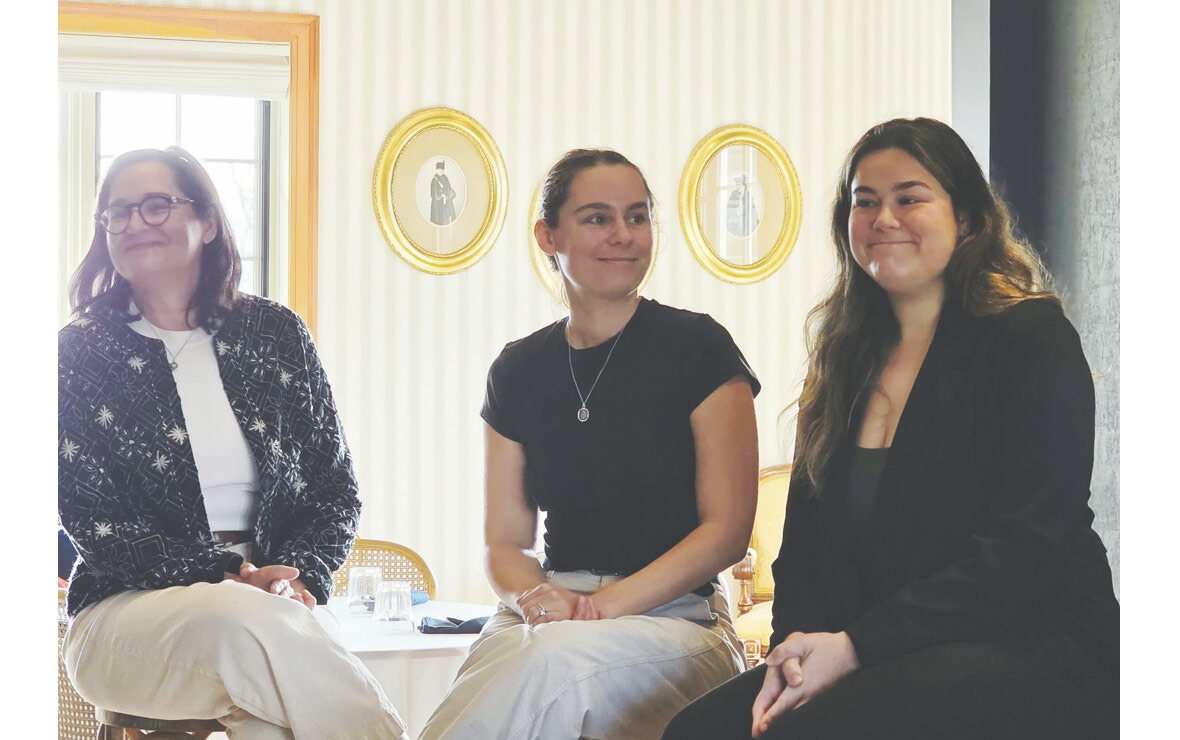
Manuela Teixeira and her daughters, Camilla Cazelais and Élisa Cazelais, told a Chambre de commerce de Gatineau luncheon at Maison O’Brien in Chelsea how they reopened the Gatineau Park heritage house in two months, and shared what working together has taught them about succession, credibility and building a family business. Photo: Tashi Farmilo
Three women and a heritage house bring new life to Meech Lake landmark
Tashi Farmilo
Maison O’Brien, the historic summer house near Meech Lake that stood empty for years, reopened this year under Manuela Teixeira and her daughters, Camilla Cazelais and Élisa Cazelais, who described how they took on the property and what working together has taught them during a luncheon in the house’s Restaurant Adèle on October 29. The event, held by the Chambre de commerce de Gatineau and presented by Bell, focused on succession, family business and hospitality.
Teixeira signed the lease at the end of February, which left about two months to prepare for a soft opening. Camilla had just had a baby. “I’m so happy we pulled it off,” Teixeira said.
Designed by architect Werner Noffke, the house was built in 1930 for businessman John Ambrose O’Brien, founder of the Montreal Canadiens and a key figure in creating the National Hockey Association. The National Capital Commission acquired it in 1964, and it later served as a government conference centre beside Willson House, where the Meech Lake Accord was negotiated.
Teixeira said she had her eye on the house for more than a decade and visited it before it was renovated. Last year, with no construction underway, she called the NCC and learned that another party was already in talks. Roughly six months of negotiations followed.
Teixeira, who grew up in an immigrant family in Old Hull, said her business began in 2007 and 2008, when she bought the Chelsea Pub. A plan to add a microbrewery did not go ahead, so she began buying the neighbouring properties instead. Around 2015 and 2016, she drew up an eight-step plan for those properties, which included expanding her first two establishments, building the Lofts du Village in two phases and opening a distillery. The plan led to six or seven years of construction, including through the sharp rise in building costs in 2020 and 2021. “It’s a tough, difficult field, but it’s very satisfying once it’s done,” she said of construction. Old Chelsea Square now includes the Chelsea Pub, the Biscotti & Cie café, the Distillerie du Square and the Lofts du Village. The company employs about 150 people, and its management team is about 80 per cent women.
Camilla was about 10 and Élisa about eight when the pub was purchased, and they started out washing glasses and dishes because they were too young to work at the cash. Camilla went on to earn a commerce degree at the University of Ottawa’s Telfer School of Management, taught in China for a year and joined the management team in 2020 to oversee the company’s accommodations.
While Élisa studied communications and marketing in Sherbrooke, then trained in cooking and gastronomy at the Institut de tourisme et d’hôtellerie du Québec in Montreal and worked in that city’s restaurants. She later joined the public relations firm Weber Shandwick, handling crisis management and media relations, mainly for McDonald’s Canada. She returned to the region in February and now runs Maison O’Brien.
Leaving first, both daughters said, was what made coming back worthwhile. “I think it’s really important to separate yourself from the family core to understand who you are, what you want to do and the philosophy you want to bring to the business you’re going to come back to,” Élisa said. Her mother agreed. “I think it’s important to go see what’s done elsewhere so you can make the best decision,” Teixeira said.
The sisters described a working relationship with fewer filters than they would have with other colleagues, and said disagreements do not linger because they grew up arguing and making up. They see their role as working behind the scenes to carry out their mother’s vision and objectives. The hardest part, they said, is switching off, since employees message them at all hours and Saturday mornings together often turn into business discussions. Camilla said her partner handles about 90 per cent of the work at home so she can do her job. Élisa said her partner chose to stay out of the business entirely to protect his relationship with her family.
The daughters said what they admire most in their mother is her calm under pressure, and Teixeira explained where it comes from. “I try to stay focused, because there are so many times when events can throw you off course,” she said. “That makes you lose your footing, and it makes you make bad decisions, too.”
Asked about the biggest myth about family businesses, the sisters said it is that the children get an easy job, noting that they still wash dishes to this day. The family named its boldest decisions as opening the first phase of the lofts in 2020 while other businesses were closing, then pressing on with the next phase and the distillery.
Earning respect as young women in charge was a recurring theme. Camilla, who oversees the company’s construction projects, said a painter once mistook her for the cleaning staff and spoke to her in an unacceptable way. “I am not a cleaning woman, I am the project director,” she said she told him, “and even if I were a cleaning woman, you would have no right to speak to me that way.” With staff, she said, the answer has been to work alongside them, and she noted that only the week before she had been cleaning rooms with her team. “I think it’s about showing that you’re approachable and putting yourself in their position,” she said. “That’s how you earn a lot of their respect.”
Élisa said her culinary training gives her credibility in the kitchen. “If you ask me to take on any role in the business here, I’m able to do it,” she said. She acknowledged that being close in age to many of her employees makes it harder to set firm expectations, and said she is learning to accept that. “He won’t like what I’m going to tell him, but it has to be done. We’re in a workplace,” she said.
Teixeira, asked how women build credibility in male-dominated industries, said it came with time after she started out in communications and then moved into business. “I think it comes down to proving yourself,” she said.
The family also offered practical advice. A finance director tracks their numbers daily so that a struggling department can be identified before it drags down the others. The panel urged entrepreneurs to be careful about whose opinions they take to heart, noting that people are rarely ill-intentioned but often project their own insecurities. The sisters said support for people taking over a family business consists mostly of coaching, with little financing available, even though money is what successors need most. One of them recalled that a university course on family entrepreneurship, covering how to know your limits, communicate and manage conflict, was being developed while she was a student, and said that kind of training would have helped.
To cope with the pace, Élisa said she starts every day with an hour-long hike with her dog before she begins work.
Work has started on outdoor facilities for hotel guests, including a small pool and a relaxation cabin, for planned three- and five-day wellness retreats with a health-focused menu, meditation sessions and talks on nutrition. The family had hoped to open them this fall, but approvals did not come quickly enough.The restaurant, named at Élisa’s suggestion in honour of O’Brien’s wife, Adèle, is open Wednesday to Sunday with a menu that changes weekly.
Asked for one word to describe the next chapter, the sisters said it would not be “relax.”
Teixeira said she has started preparing to step back into the role of mentor, though she does not intend to leave. “I’ll still be there, but maybe I’ll be making coffee, because I love that,” she said. “I love being in contact with people.”
Moderator Sophie Perreault, founder of the Gatineau hand-painted tableware workshop Pero, stepped in for the scheduled host and closed with her own takeaway from the afternoon. “Succession is not a transfer of power, but a conversation between generations,” she said. “When you build on trust, complementarity and authenticity, the strongest businesses are sometimes the ones built around the same table.”