
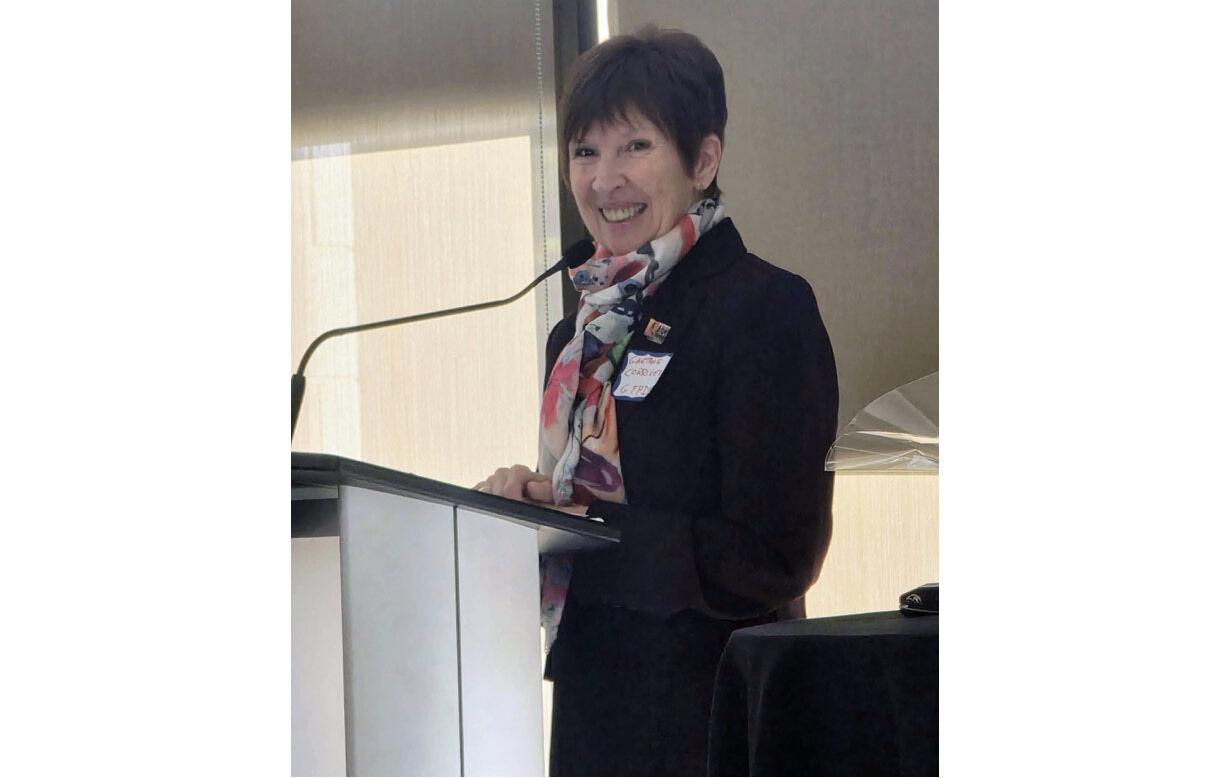
Political scientist Gaëtane Corriveau told an AGIR Outaouais forum in Gatineau on October 23 that equality between women and men exists in law but not in daily life, as participants examined persistent pay gaps, a dip in women’s council representation and practical ways for Outaouais municipalities to turn equality policies into action. Photo: Tashi Farmilo
Outaouais municipalities urged to turn equality pledges into action
Tashi Farmilo
Equality between women and men remains more aspiration than reality in Outaouais municipalities, a regional forum organized by AGIR Outaouais heard October 23, as mayors, councillors, municipal staff and community workers gathered at the Canadian Museum of History in Gatineau to look for ways to move local governments from good intentions to concrete change.
The forum, built around the idea of moving from words to action, was open to the 41 municipalities of the region’s four regional county municipalities and to the City of Gatineau. It closes a three-year agreement on equality between AGIR, the provincial government, the City of Gatineau and the MRCs of Collines-de-l’Outaouais, Papineau and Pontiac. Organizers asked everyone in the room, whether from a village of a few hundred people or from the region’s largest city, to leave with at least one step they could take at home.
What emerged over the morning was a portrait of a region where the rules on paper treat women and men the same, but daily life does not. Political scientist Gaëtane Corriveau, who spent 17 years with the Groupe Femmes, Politique et Démocratie, drew a line between equality guaranteed by law, which Quebec and Canada largely achieved with their human rights charters, and equality as people live it, which she said is still out of reach.
Her evidence began with paycheques. In the MRC des Collines-de-l’Outaouais, among the most affluent areas of the region, women aged 25 to 64 earn a median of $66,300 from employment, while men earn $83,400. Smaller gaps, though still several thousand dollars, appear in Papineau, Pontiac and the Vallée-de-la-Gatineau. Across Quebec, women still earn about $3.60 less an hour than men. Women are more likely to work part time and to head single-parent families, she noted, and the pandemic widened those gaps when schools closed and restaurant and hotel jobs, many held by women, disappeared.
The picture at council tables is mixed. Women now hold a slightly larger share of mayor’s chairs in the Outaouais than the provincial average, but their share of council seats in the region fell in the 2025 municipal elections, even as it rose across Quebec. For Corriveau, that small retreat matters more than its size suggests. It contradicts the comfortable assumption that women’s progress in politics moves steadily forward on its own, like traffic on a highway. Progress can stall and slide back, she argued, unless someone keeps pushing.
Corriveau cautioned municipalities against treating 40 per cent women as a finish line. Women make up half the population, she reminded them, and true representation means a council where women hold between 45 and 55 per cent of seats. It is at that point, she said, that the dynamics of power in a room begin to change, when women are no longer interrupted, when their ideas are no longer ignored until a man repeats them and is praised for his insight.
The provincial stage offered a timely example. The Parti Québécois government that took office recently, after the October 5 election, has nine women among its 22 ministers, short of parity, with the major economic portfolios in the hands of men. Corriveau encouraged the region’s elected women to build alliances with women at the National Assembly regardless, to carry the Outaouais’s concerns to Quebec City.
Contrary to a widespread belief, voters themselves do not appear to punish women at the ballot box, Corriveau said, citing longstanding research on Canadian elections. The obstacles lie elsewhere: in the juggling of jobs, children, studies and aging parents; in stereotypes everyone carries, often without knowing it; in old-boys' networks and access to campaign money; in party machinery that sometimes sidelines a local woman who spent years building support in favour of a candidate chosen from above; and in the harassment and online abuse that elected officials increasingly face. Indigenous women, Black and racialized women, women with disabilities, young women and women in rural or low-income areas face those barriers several times over.
She traced the roots back to ancient Athens, where democracy was born with women confined to the home, and noted that Quebec women won the right to vote only in 1940. Systems designed over centuries without women, she argued, do not correct themselves simply because the law changes.
Violence remained the heaviest subject of the morning. Corriveau noted that 19 women have died in feminicides in Quebec so far this year, and that shelters still lack space for women and children trying to escape.
The region is not starting from zero. Four of the region’s five territories have adopted equality policies, and Gatineau’s, championed by Orée-du-Parc councillor Isabelle N. Miron, became a model elsewhere in Quebec. The town of Montmagny drew on it in shaping its own policy, which won a provincial municipal award in 2025. The challenge now, Corriveau said, is to take those policies off the shelf and give them action plans, measurable goals, budgets and a person responsible for seeing them through.
Questions from the floor revealed how differently people in the room experience the issue. A sociology doctoral student who recently arrived in Canada to study at the University of Ottawa said he was startled by the numbers, having assumed a wealthy country like Canada had long since resolved such questions. Catherine Pellerin, mayor of Bowman in Papineau, where women have held four council seats for two terms, wondered whether the real hurdle is women hesitating to run or voters doubting them once they do. Corriveau answered that placing the burden on individual women’s confidence misses the point and warned that masculinist ideas spreading online and on radio talk shows are leaving some young men more conservative than their grandfathers.
Miron said Gatineau has no shortage of strong women to look up to, but that once elected, women find no road map for governing in a feminist way. Another participant, who left elected office after just six months, said the experience convinced her that electing women is not enough if politics itself stays polarized and unwelcoming.
The second speaker, inclusive design consultant Christelle Montreuil, widened the lens to accessibility. Asked what share of the population will at some point live with a disability, most participants guessed about two-thirds. Her answer was everyone. A broken leg, an eye infection, a stroller and an armful of groceries, a trip abroad without the local language, or simply growing older can all turn an ordinary building or service into an obstacle course. The public’s mental image of disability, shaped by the wheelchair symbol, leaves out the many limitations no one can see, such as chronic pain and fatigue.
Montreuil distinguished between giving everyone the same tools, adapting tools for those who need them, and removing the barrier altogether. She asked the room to imagine a fence that blocks some people but exists for safety. Within seconds, participants proposed a transparent barrier, an opening, or a warning sign. If a solution can be found that quickly, she said, municipalities given weeks or months can certainly find inclusive answers that also respect safety and budgets.
Her examples hit close to home. Residents struggle to decode garbage and bulky-item collection schedules divided into sectors no one can identify. Notices of road closures reach those with smartphones and email but not seniors without either. Small changes, she said, can make a large difference: seats near a service counter, captions on videos, clear wording on websites, varied hours at libraries and recreation centres, and the option of submitting comments before or after a public consultation. Her firm is helping Gatineau prepare guides for municipal staff and design a new sports centre with gender-neutral washrooms and universal change rooms. In one study her team conducted, nearly everyone entering a building went out of their way to use the automatic doors, whatever their abilities, a sign that what is built for some ends up serving all.
In a morning workshop, participants ranked the main brakes on progress in their municipalities. A lack of awareness and education came first, followed by equality not being treated as a priority, a tolerance for incivility in municipal life, friction between elected officials and administrators, and the financial strain on small municipalities. Several participants pushed back on the idea that money is the main obstacle, noting that measures such as gender-inclusive writing cost nothing.
A worker from a Gatineau women’s shelter offered a sobering observation, pointing out how few Indigenous and racialized people were in the room. Barriers, she reminded participants, look very different depending on who faces them.
The forum also honoured two longtime figures in the region’s women’s movement, facilitator Lynne Bouchard and former AGIR director Hamida Melouane, who devoted 23 years to the organization.
The afternoon brought a panel featuring Papineau prefect Paul-André David, Nicolas Côté of the Gatineau police service, political affairs adviser Olivia Scieur-Aparicio and AGIR’s Riantsoa Andriamasy, followed by workshops on solutions. Participants will receive a report on the day’s conclusions.
Corriveau ended with a reminder that inequality is not destiny. Change, she suggested, will require municipalities to pool not only their collective intelligence but their collective heart.