
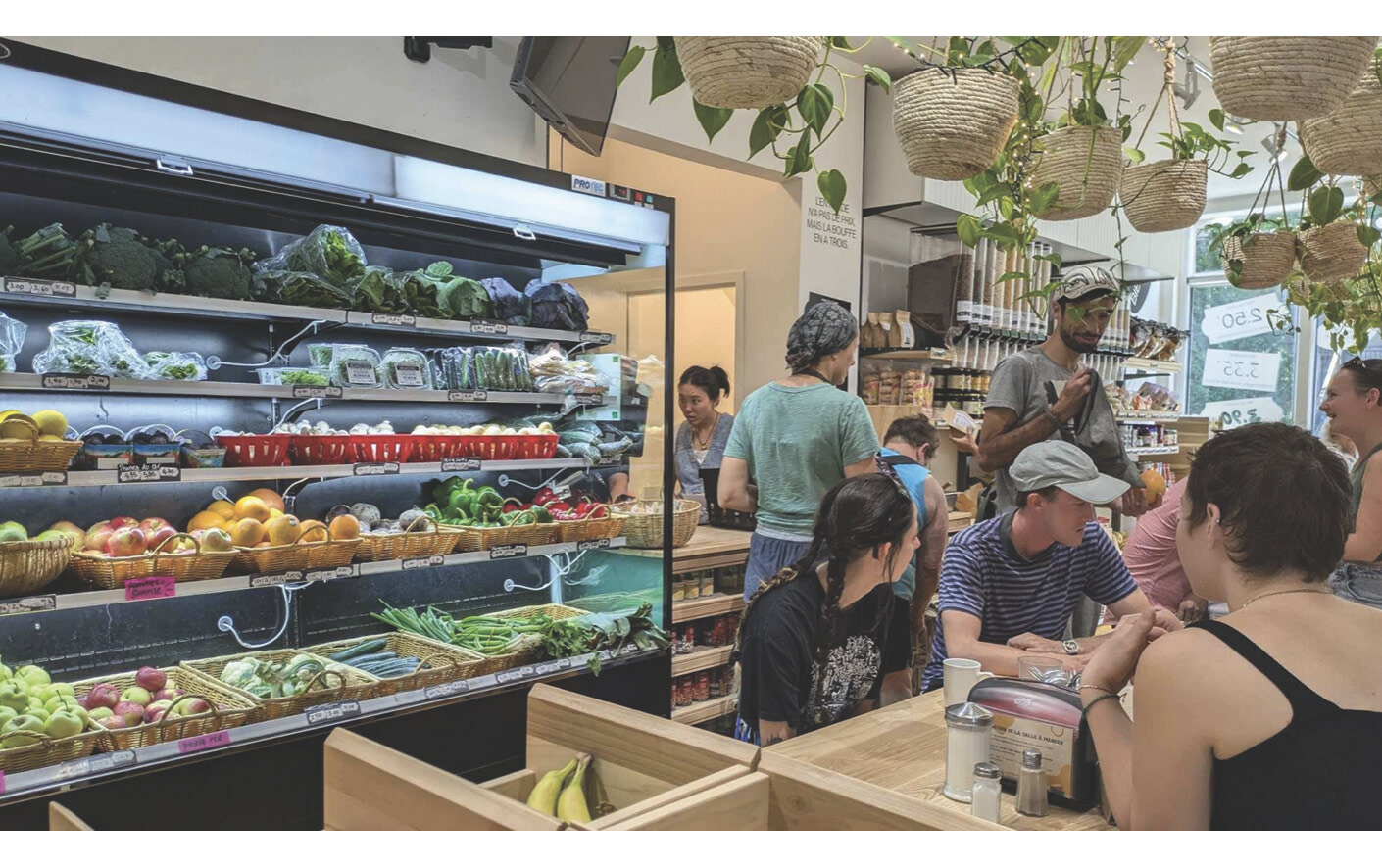
A new Équiterre report found that roughly one in seven Quebec post-secondary students did not have enough to eat in the past year, with many unaware of available help or too ashamed to ask for it, a situation that a regional Outaouais organization says is playing out on local campuses as well. Photo: Courtesy of the Table de Concertation sur la Faim et le Développement Social de l'Outaouais Facebok page
One in seven Quebec post-secondary students lack enough food report finds
Tashi Farmilo
A new provincial report released by environmental organisation Équiterre and two Quebec student federations found that roughly one in seven post-secondary students did not have enough to eat in the past year, a finding that a regional hunger-focused roundtable in the Outaouais says reflects what it is already seeing on local campuses.
The report, published in late 2025 and based on an online survey of 667 students at colleges and universities across Quebec, was produced as part of a project called "Mobilisation étudiante pour bien manger, bon marché," a collaboration between Équiterre, the Fédération étudiante collégiale du Québec and the Union étudiante du Québec. The Table de Concertation sur la Faim et le Développement Social de l'Outaouais, which runs its own student food security initiative called Aliment'Action étudiante, highlighted the report on social media, describing student food insecurity as a reality that remains too present in college and university settings across the province.
Fourteen per cent of survey respondents said they sometimes or often lacked sufficient food in the twelve months preceding the survey, while 26 per cent said they had used some form of food assistance during the same period. The authors caution that the sample over-represents women, international students, and those already experiencing food difficulties, and that results should be treated as directional rather than definitive.
International students stood out as particularly at risk. Among the 127 international students in the sample, only 27 per cent said they had sufficient access to all the foods they wanted, compared to 49 per cent of respondents overall. More than half said they wished they had better kitchen equipment, and the data confirmed they faced a significantly higher likelihood of food insufficiency than their domestic peers.
Despite widespread need, half of those who said they did not have enough to eat had never sought food assistance. The most commonly cited reasons were a lack of awareness of available resources, a sense of not being needy enough to qualify, and a shortage of accessible help. Several respondents also described reluctance to be seen seeking assistance, a pattern the report characterises as a silent crisis. More than half of all participants said they would not know where to turn for food help if they needed it.
Students tended to prefer solutions that did not require registration or identification. Restaurants and cafés offering occasional free or subsidised meals ranked as the most popular option, followed by solidarity-priced grocery access and community fridges. These were favoured over traditional food banks partly because they carry less stigma. Community fridges were the most widely recognised form of campus food support, particularly at CEGEPs, though many respondents noted they empty quickly after being restocked and that demand consistently outpaces supply.
Campus cafeteria costs drew repeated criticism. Students described prices as incompatible with a student budget and pointed to food service companies operating on campus without meaningful price oversight from institutions. Nutritious options including fruits, vegetables, and protein sources were frequently identified as disproportionately expensive, pushing students toward cheaper but less nutritious food.
Nearly half of all respondents said they were unaware of any food assistance programme on their campus, a figure that rose to 57 per cent among university students. The report recommends a communication strategy combining online platforms, physical campus presence, student services, and community spaces, noting that no single channel reached a majority of students on its own.
The authors raise a broader structural concern, noting that students are rarely treated as a vulnerable population in provincial or federal food security policy. They argue this institutional invisibility is troubling given research linking student food insecurity to poorer academic outcomes and higher rates of food insecurity in adulthood.
Both of the Outaouais region's main post-secondary institutions, the Cégep de l'Outaouais and the Université du Québec en Outaouais, were represented in the survey sample, though with too few respondents to draw campus-specific conclusions.