
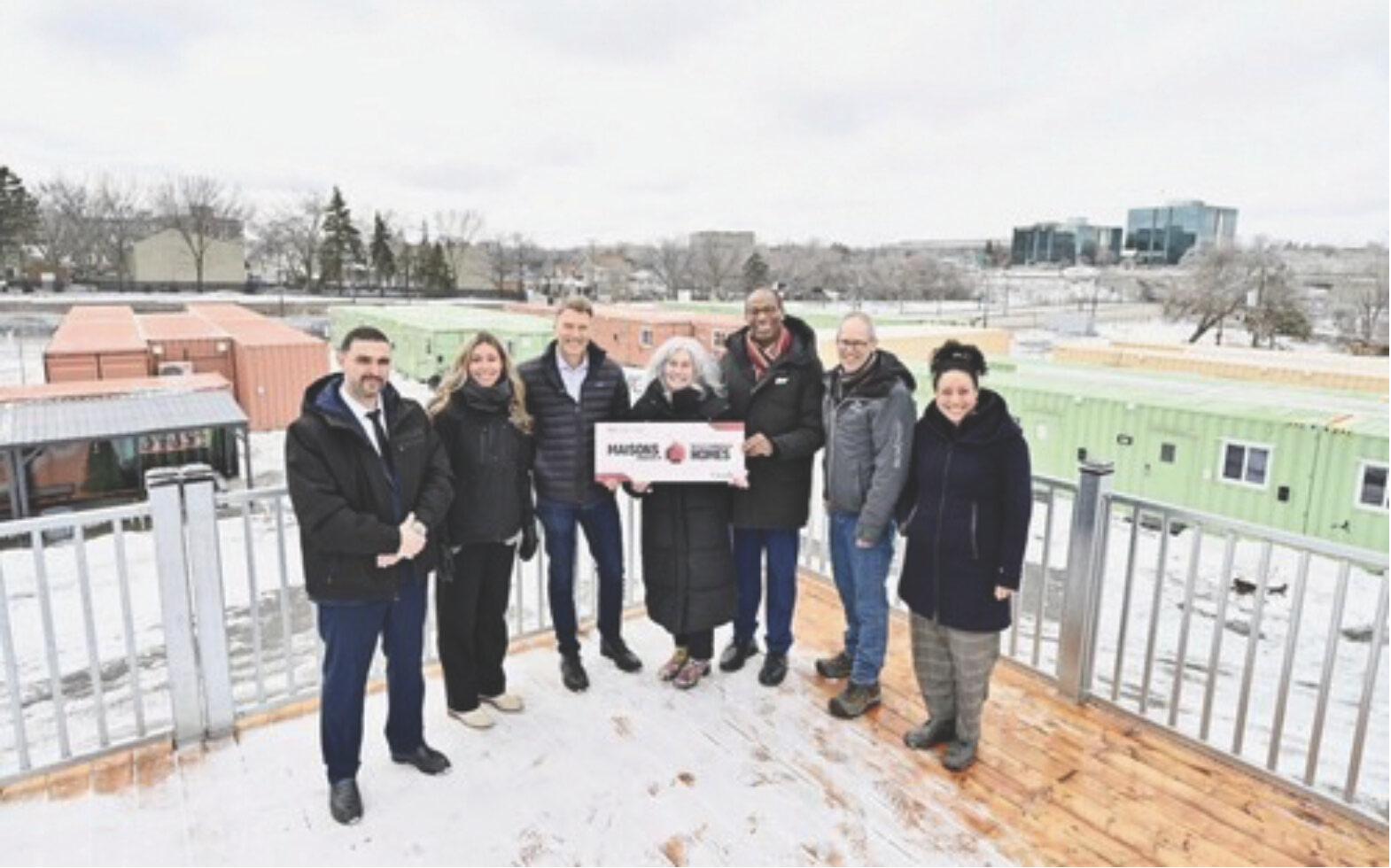
Federal officials and Gatineau's mayor gathered at the Village Transitiôn site on March 13 to announce $2.5 million in federal funding for the innovative transitional housing project. From left: Housing Minister Gregor Robertson, Hull-Aylmer MP Greg Fergus, and Gatineau Mayor Maude Marquis-Bissonnette. Photo: CNW Group/Canada Mortgage and Housing Corporation
Hope has a new address in Gatineau
Tashi Farmilo
The Village Transitiôn project in Gatineau, a community of repurposed shipping containers housing roughly 100 people experiencing homelessness, received $2.5 million in federal funding on March 13, the latest contribution to a project that has drawn support from every level of government as well as the private sector.
Gatineau had been watching its homelessness crisis deepen for years. The number of people without stable housing in the city and the broader Outaouais region climbed from 145 in 2018 to 534 in 2022, nearly a fourfold increase in four years. The parking lot beside the old Robert-Guertin Centre arena in Vieux-Hull became the most visible sign of that pressure, with a tent encampment growing year over year in dangerous conditions: open drug use, fires started by people trying to keep warm, and ultimately, death.
Two people died there in the fall of 2023. On November 16, a 47-year-old construction worker named Marc Jodoin was found unresponsive inside a tent and later pronounced dead, his death eventually ruled accidental by a coroner. A second man died on the evening of December 5, found unconscious and pronounced dead at hospital. Those deaths accelerated efforts to find a more structured solution.
Devcore, a local real estate developer, erected 48 heated, fire-resistant tents on the lot in December 2023, enclosed within a secure perimeter with toilets, a warming space and security. The company's managing partner said simply that enough was enough. That arrangement ran until the following spring under a temporary city-approved agreement. The City of Gatineau then lent the land at no cost for ten years and contributed $1.5 million toward what would become the permanent replacement. The Quebec government added $1.14 million in startup funding plus nearly $900,000 annually in rent subsidies. Devcore provided a $2-million construction loan and announced plans for Village Transitiôn, built from roughly 60 converted shipping containers, considered the first project of its kind in Quebec and the largest of its scale anywhere in Canada. The non-profit Transitiôn Québec was brought in to manage it.
The village welcomed its first residents just before Christmas 2024, with the initial 40 units fully occupied within a month. Units range from modest bachelor rooms to studios with a full kitchen and private terrace. Every unit comes with heat, air conditioning and internet. The grounds include stone pathways, a dog park, shared kitchens and a bike repair station, all designed to feel like a neighbourhood rather than a shelter. Residents contribute rent of roughly 25 per cent of their income, typically between $200 and $500 a month, a structure Transitiôn Québec considers essential to building personal responsibility.
The financial case is compelling. Provincial research puts the cost of one person experiencing homelessness at roughly $70,000 a year once health care, policing and social services are factored in. The village houses that same person for around $20,000, a gap that Nancy Martineau, executive director of Transitiôn Québec, estimates could save taxpayers roughly $50 million over the ten-year lease.
The March 13 announcement was made by federal Housing Minister Gregor Robertson, alongside Hull-Aylmer MP Greg Fergus and Gatineau Mayor Maude Marquis-Bissonnette. Robertson said the project would "quickly address the urgent housing needs of Gatineau's most vulnerable people." Fergus described it as evidence that government can help communities build their own answers to housing insecurity, saying Village Transitiôn "provides a safe place for some of our most vulnerable residents." Marquis-Bissonnette noted that "Gatineau is particularly affected by the homelessness crisis" and called the federal commitment essential to finding lasting solutions.
With federal funding now secured, Martineau said the project points toward something larger. "Village Transitiôn shows that it's possible to rethink how we act when it comes to homelessness. Thanks to CMHC's support, we were able to create a safe and caring living environment that allows people to regain stability and their place in the community. This project shows that by focusing on innovation and collaboration, it is possible to develop inspiring solutions for other communities across Canada."