
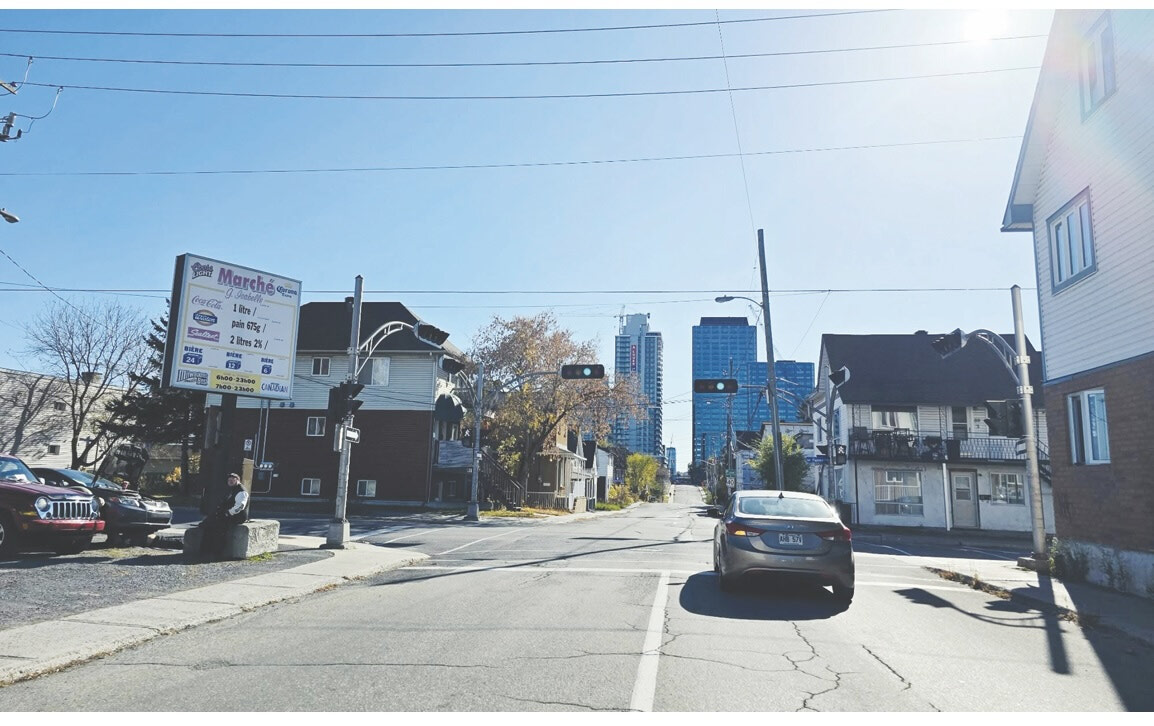
Gatineau and the rest of the Outaouais saw the biggest jump in household income of any Quebec region in 2024, but job openings then fell more steeply than anywhere else in the province, according to the Institut de la statistique du Québec’s latest regional portrait. Photo: Tashi Farmilo
Gatineau region leads Quebec in income growth but lags on jobs and electric vehicles
Tashi Farmilo
Household incomes in the Outaouais rose faster in 2024 than anywhere else in Quebec, but the region’s job market then cooled more sharply than any other, according to a wide-ranging regional portrait released November 2 by the Institut de la statistique du Québec. The provincial statistics agency says the income gain came mostly from fatter paycheques in a region where the public sector makes up nearly half of the economy.
The report, Panorama des régions du Québec, is published every year. It ranks Quebec’s 17 administrative regions on everything from population and employment to home values, health care, tourism, access to parks and use of electric vehicles. It also breaks the numbers down for the province’s regional county municipalities, or MRCs. In the Outaouais, those are the City of Gatineau, Les Collines-de-l’Outaouais, Papineau, Pontiac and La Vallée-de-la-Gatineau.
Most of the report’s figures date from 2024 and 2025 because of how the data is collected. Annual job averages can only be calculated once a year is over. Income and economic output figures take even longer, because they depend on tax and government records, so the institute treats its 2024 numbers as preliminary. Property values lag by design: this year’s assessment rolls reflect market prices as of July 1, 2024. The electric vehicle counts are the most current figures in the report.
The headline finding for the region is income. Disposable income, the money residents have left to spend or save after taxes, plus any government benefits, averaged $36,408 per person in the Outaouais in 2024. That was up 6.1 per cent from the year before, the biggest increase of any region and well ahead of the provincial gain of 4.9 per cent. A year earlier, the region had grown by only 2.5 per cent. The institute credits faster wage growth above all, with help from rising rental and investment income. Even with the jump, Outaouais residents still had less to spend than the average Quebecer, whose disposable income was $38,426.
The gap is wide within the region. In Les Collines-de-l’Outaouais, which includes Chelsea, Cantley and La Pêche, disposable income averaged $41,776 per person, among the highest of any MRC in Quebec. Gatineau came in at $35,859, Papineau at $35,004 and La Vallée-de-la-Gatineau at $34,488. Pontiac, at $32,079, was among the lowest in the province.
The report also shows how heavily the region relies on the public sector. Education, health care, social services and public administration together made up 46.9 per cent of the Outaouais economy in 2024. That is nearly twice the provincial share of 24 per cent and the highest of any region, mostly because of government offices. The region’s total economic output, or gross domestic product, rose 6.3 per cent to about $20.5 billion, and the public sector portion grew 7.8 per cent. Output per resident was $48,169, well below the provincial figure of $63,479.
By 2025, the labour market had turned. The region averaged about 2,800 vacant jobs that year, down from roughly 7,100 in 2022. That 60 per cent drop was the steepest in Quebec, where vacancies fell by half over the same period. Only 2.4 per cent of jobs in the region were vacant, tied with Saguenay-Lac-Saint-Jean for the lowest rate in the province. In practical terms, there were about five unemployed people for every open position in the Outaouais, compared with just over two across Quebec. That was the highest ratio in the province, which means job seekers here face the stiffest competition.
Unemployment among residents aged 15 to 64 climbed to 6.7 per cent in 2025, up from 5.7 per cent a year earlier and 3.6 per cent in 2022. The provincial rate was 5.6 per cent, although the survey sample is small enough that the institute could not say the regional rate was meaningfully higher. The share of working-age residents with a job slipped to 75.5 per cent, below the provincial 77.4 per cent. Employers who were still hiring had to pay more: the average hourly wage offered for vacant jobs rose 8.5 per cent to $28.05, one of the biggest increases in Quebec, though still a little below the provincial average of $28.55.
Older workers in the region are less likely than in most of Quebec to still have a job. About 56 per cent of Outaouais residents aged 55 to 64 were employed in 2025, up from about 50 per cent in 2011 but well below the provincial rate of about 64 per cent. Tax data for 2024 show a similar split within the region. More than 83 per cent of residents aged 25 to 64 in Les Collines-de-l’Outaouais reported employment income, compared with about 69 per cent in Pontiac and La Vallée-de-la-Gatineau, among the lowest rates in the province. Les Collines-de-l’Outaouais was one of only two metropolitan-area MRCs where women were more likely than men to be working. The institute links that to its proximity to a major government centre where women hold a large share of jobs.
The Outaouais is still one of the youngest regions in Quebec. It had 428,751 residents on July 1, 2025, with an average age of 42. Seniors made up 19.5 per cent of the population, one of the lowest shares in the province, and children and teens under 20 still slightly outnumbered them. Growth slowed sharply, however, falling by half from the year before to 8.7 new residents per 1,000. The institute calls that weak by the region’s usual standards. Most of the growth came from international newcomers, and births only barely outnumbered deaths. The population estimates will be revised early next year, with a bigger revision to follow once results from this year’s census are in.
Les Collines-de-l’Outaouais grew fastest, adding 14.6 residents per 1,000. The institute says the MRC attracts young families, much as the suburbs around Montreal and Quebec City do. Gatineau, with 306,105 residents, remains young for a large city, with fewer than one in five residents aged 65 or older. The rural north and west are much older. Seniors make up more than 30 per cent of the population in La Vallée-de-la-Gatineau and close to that in Papineau and Pontiac, where the average age is between 47 and 49.
Home values have soared over the past decade. The average single-family home in the region is valued at $482,983 on this year’s assessment rolls, almost double the $248,162 of 10 years ago. That is average annual growth of 6.9 per cent, a little faster than the provincial pace. The institute says the biggest increases across Quebec were mostly in fast-growing areas on the edges of big cities, a sign that housing pressure is moving out of the major centres. More recently, the Outaouais has eased: the latest increase, 4.9 per cent, was among the smallest in the province, and the regional average is still below Quebec’s average of about $499,000. Condominiums averaged $340,554, up 4.5 per cent.
Residents enjoy better access to green space than anyone else in Quebec, helped by Gatineau Park. The region has nearly 41,000 hectares of urban parks, trails and recreational land, the most of any region. Almost half of residents live within 300 metres of one, compared with 37 per cent across the province. The figure is about 60 per cent in Gatineau’s denser neighbourhoods but only 18 per cent in sparsely populated areas. Wealthier households are better served: 53 per cent of households earning $125,000 or more after tax live near green space, compared with 41 per cent of those earning less than $40,000.
On health care, about 86 per cent of adults in the region are registered with a family doctor, a family medicine group or a nurse practitioner. That is slightly above the provincial rate of 82 per cent, though not by enough for the institute to call it a real difference. Residents were less likely than other Quebecers to have needed a routine annual checkup and more likely to have needed a psychologist or psychotherapist, about one in five adults. They were also more likely to have private insurance for dental care, eye care, physiotherapy and psychology. The institute suspects this is because the region has so many government employees, who usually have group benefits.
Tourism held steady. The Outaouais tourism region had 102 hotels and tourist residences in 2025. Rooms were 62.5 per cent occupied on average; rental revenue rose 5.5 per cent to $137.8 million; and the average price per unit rented was $194.50. Campgrounds were about 79 per cent full over the summer, almost the same as the year before. Ready-to-camp units such as yurts and cabins were only about half full.
On electric vehicles, the region is falling behind. As of March 31, there were 15,172 electric cars and light trucks on Outaouais roads, compared with 1,295 in 2019. That works out to 422 electric vehicles for every 10,000 residents aged 15 and older, well below the provincial figure of 582. About a third of them are plug-in hybrids. Charging stations have not kept pace. The Outaouais was the only region where the number of public Level 2 chargers fell over the past year, even as fast chargers increased by nearly a third. Each public station now serves an average of 36 vehicles, a 10.8 per cent increase that was second only to Lanaudière’s.