
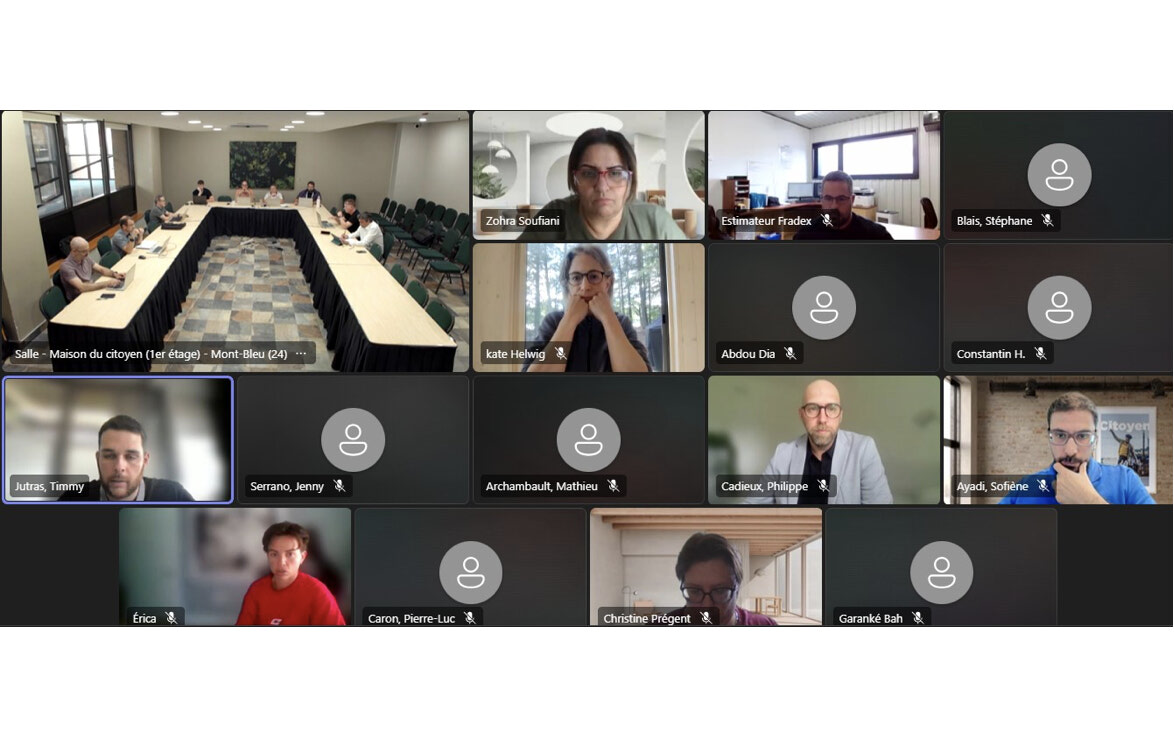
Gatineau's planning advisory committee reviewed 11 building proposals at its August 17 meeting, most of them new housing, in the early, little-seen step that shapes what gets built across the city's neighbourhoods before council makes the final call. Photo: screenshot of the comité consultatif d'urbanisme, August 17 meeting
Apartments, triplexes and a church: Gatineau's planning committee weighs 11 projects
Tashi Farmilo
Gatineau's planning advisory committee met on August 17 to review 11 building and land-use proposals from neighbourhoods across the city, from new apartment buildings in Aylmer to a proposed church in the east end. The committee discussed three requests from Aylmer, three from Gatineau and five from Hull, then gave its recommendations to city council.
The committee, called the comité consultatif d'urbanisme, or CCU, is involved at the early stage of the process. Its role is to study planning requests and advise council on any necessary changes and whether they should approve them. It does not make the final decision, but councillors rely on CCU's recommendations, so its view can shape a project well before the matter reaches a public council vote.
In Aylmer, two of the three requests were to put up eight-unit apartment buildings, one at 28 rue Symmes and one at 78 rue de la Fabrique, while the third was to replace the siding on a home at 10 rue Broad. In the Gatineau sector, one owner wants to build three triplexes at 2377, 2381 and 2385 rue Saint-Louis; another is asking for permission to hold religious services in the former furniture store at 425 boulevard Maloney Est; and a third is seeking to allow health and social services practices at 79 rue Lucienne-Bourgeois. In Hull, the requests ranged from a three-storey triplex at 104 rue Kent and the conversion of a single-family home into a triplex at 125 rue Caron, to a larger commercial building at 1-5 boulevard du Casino, an eight-unit apartment at 80 rue Frontenac, and a new porch and staircase at 86-88 rue Montcalm.
Behind each of those proposals is a process that rarely draws attention. When a project does not quite fit the existing rules, the owner must ask permission, and there are a few ways to do that. Sometimes it is a small exception to a rule about height, setbacks or how close a building sits to its neighbour. Sometimes it is a design review, to check that a new building suits the character of the area. Other times it is a request to allow a use that the neighbourhood's zoning does not normally permit, such as a church or a clinic, or a one-off approval for a project that bends the rules under strict conditions. The committee measures each request against the city's planning rules and forms its recommendation on that basis. The process can be a long one. A consultant told the committee during the meeting that his clients had been working through revisions on their Hull project for nearly three years.
For anyone who wants a say, the timing is a useful thing to know. The committee's discussions are held behind closed doors, so residents cannot sit in on the debate, but they can still speak to it. Every meeting includes a public question period of up to 30 minutes, and anyone may address the committee, in person at the Maison du citoyen, by videoconference or by sending written questions or comments beforehand. Taking part by videoconference requires registering by email at comitescommissionstables@gatineau.ca by noon the day before. The committee meets about once a month, with its next sessions set for August 31, September 28 and October 26, all at 3 pm. The CCU's schedule, agendas, the minutes that include what the committee recommended, and the video of its public portions are posted on the city's website at gatineau.ca.
The committee is chaired by councillor Caroline Murray and includes two other councillors, vice-chair Michael Korhonen, the independent councillor for Masson-Angers, and Adrian Corbo of Action Gatineau, who represents Manoir-des-Trembles–Val-Tétreau, along with seven residents appointed by the city, at least one of whom has planning expertise. Its recommendations are advice, not verdicts. Each proposal will come back to a public council meeting, where the decision is settled, and residents can raise questions about them there as well, during the council's own question period, in addition to speaking to the committee at an earlier stage.